
Tube packaging is widely used in the cosmetic, pharmaceutical, food, and daily chemical industries. Products such as toothpaste, cream, ointment, gel, lotion, and adhesive are commonly packed in tubes because tube packaging is hygienic, convenient, and attractive.
To improve production efficiency and packaging quality, manufacturers use automatic tube filling machines. But how does a tube filling machine actually work?
In this article, we will explain the complete working process of a tube filling machine, including its main components, applications, and advantages.
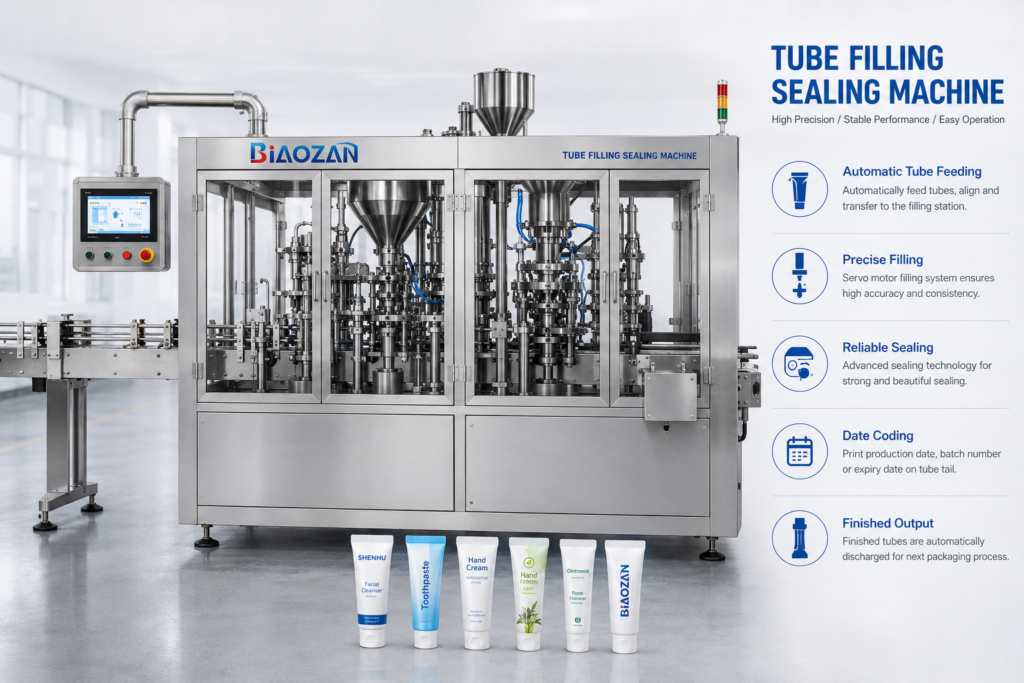
What Is a Tube Filling Machine?
A tube filling machine is an automatic packaging machine designed to fill liquid, cream, paste, or semi-liquid materials into plastic or aluminum tubes and then seal the tube ends securely.
These machines are widely used for:
- Toothpaste
- Cosmetic cream
- Facial cleanser
- Ointment
- Gel products
- Food paste
- Pharmaceutical cream
Depending on production requirements, tube filling machines can be:
- Semi automatic
- Fully automatic
- Rotary type
- Linear type
Main Components of a Tube Filling Machine
A standard automatic tube filling sealing machine usually includes several important systems.
Tube Loading System
This system automatically feeds empty tubes into the machine holder for continuous operation.
Filling System
The filling system accurately injects the product into the tube using piston or servo filling technology.
Sealing System
The tube tail is sealed by hot air sealing, ultrasonic sealing, or folding technology depending on the tube material.
Coding System
Production dates, batch numbers, and expiry dates can be printed on the tube tail.
Discharge System
Finished products are automatically discharged onto the conveyor for further packaging.
How Does a Tube Filling Machine Work?
The working process of a tube filling machine is usually divided into several automatic steps.
1. Tube Feeding
Empty tubes are manually or automatically loaded into the hopper.
The machine then transfers each tube into a rotating holder or workstation.
Automatic tube loading helps improve production speed and reduce labor costs.
2. Tube Orientation
For printed tubes, the machine uses a photoelectric sensor to identify registration marks.
This ensures the tube logo and graphics are aligned correctly during sealing.
Accurate positioning is especially important for cosmetic and pharmaceutical packaging.
3. Product Filling
The filling nozzle enters the tube and injects the product according to the preset filling volume.
Common filling materials include:
- Cream
- Lotion
- Toothpaste
- Gel
- Ointment
- Honey
- Sauce
Modern servo filling systems provide:
- High filling accuracy
- Stable performance
- Reduced material waste
This step is one of the most important parts of the entire tube filling process.
4. Tube Heating and Sealing
After filling, the tube moves to the sealing station.
For plastic tubes:
- Hot air sealing or ultrasonic sealing is commonly used.
For aluminum tubes:
- Folding and crimp sealing technology is applied.
The sealing system ensures:
- Leak-proof packaging
- Clean appearance
- Strong sealing quality
5. Date Coding
The machine can automatically print:
- Manufacturing date
- Expiry date
- Batch number
This function is especially important in pharmaceutical and food industries.
6. Finished Product Output
After sealing and coding, the finished tubes are automatically discharged onto a conveyor.
The products can then move to:
- Labeling machines
- Cartoning machines
- Case packers
to create a fully automatic packaging line.
Applications of Tube Filling Machines
Tube filling sealing machines are widely used across many industries.
Cosmetic Industry
Suitable for:
- Facial cleanser
- Sunscreen
- Hand cream
- Lotion
- Hair gel
Pharmaceutical Industry
Used for:
- Medical ointment
- Antibiotic cream
- Gel medicine
Food Industry
Suitable for:
- Chocolate sauce
- Honey
- Condensed milk
- Food paste
Daily Chemical Industry
Used for:
- Adhesive
- Shoe polish
- Cleaning paste
Advantages of Automatic Tube Filling Machines
High Efficiency
Automatic machines greatly improve production capacity and reduce labor requirements.
Accurate Filling
Servo systems ensure precise filling volume and stable performance.
Hygienic Packaging
Stainless steel structure and enclosed filling systems meet GMP standards.
Strong Sealing Performance
Professional sealing technology helps prevent leakage and extend shelf life.
Easy Operation
PLC touch screen systems make machine operation simple and user-friendly.
How to Choose the Right Tube Filling Machine
Before purchasing a tube filling sealing machine, manufacturers should consider:
- Tube material
- Product viscosity
- Production speed
- Filling accuracy
- Automation level
- Factory budget
Choosing the right machine can improve production efficiency and packaging quality.
Why Choose Shanghai Biaozan?
As a professional packaging machine manufacturer in China, Shanghai Biaozan Machinery Co., Ltd. provides reliable tube filling sealing machines for cosmetic, pharmaceutical, food, and chemical industries.
Our advantages include:
- Customized machine solutions
- Stable machine performance
- Competitive factory prices
- Professional technical support
- Complete after-sales service
We help customers improve packaging efficiency and reduce production costs.
Conclusion
Tube filling machines play an important role in modern packaging production. From tube feeding and filling to sealing and coding, the entire process is highly automated and efficient.
Whether you are producing toothpaste, cosmetic cream, ointment, or food paste, an automatic tube filling sealing machine can help improve packaging quality and increase production efficiency.
If you are looking for a reliable tube filling machine manufacturer, Contact Shanghai biaozan today for machine details and quotation.